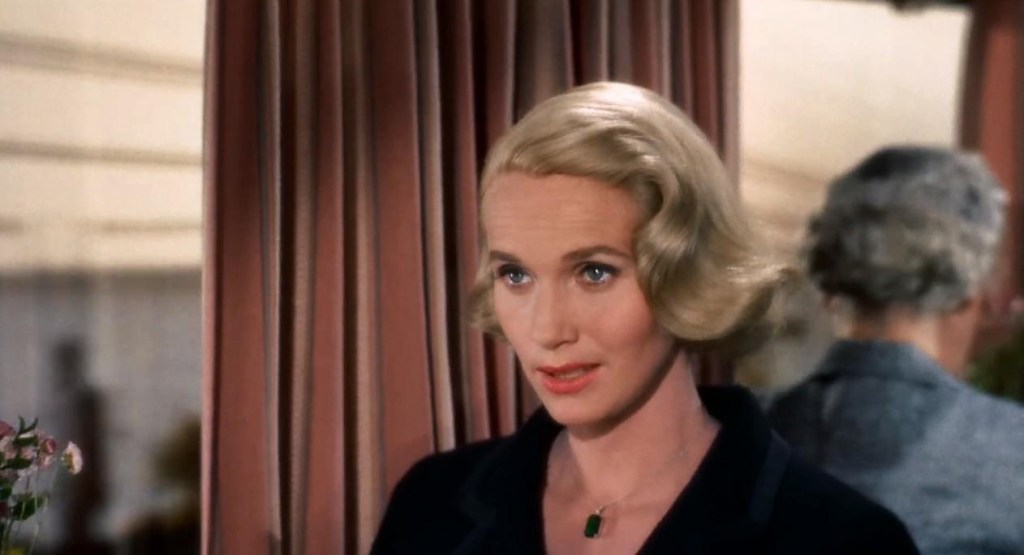
We are deeply saddened to share the passing of Eva Marie Saint (1924-2026) who has died at the age of 102. She was born on July 4th and was an All American lady with grace and charm.
We were fortunate to interview Eva Marie a couple of times: first in 1999 during the centennial of Hitchcock’s birth at the NYU conference in New York. And the second in 2012 when she defended Alfred Hitchcock against media accusations.
Eva said she loved working with Hitchcock and called him her ‘sugar daddy’ as he took her to Bergdorf’s to find clothes for her Eve Kendall character in North by Northwest. You can read some of her interview in A Century of Hitchcock by Kentucky Press.
As she said, “There were six of us [Alfred Hitchcock] blondes, and it’s like we were all married to the man at one time or another. And we all have a different take on him. Each actress was at a different stage of her life; we were different ages, some married, some not. My experience with Hitch was one of utter respect, warmth, friendliness and humor, and NORTH BY NORTHWEST (’59) was a glorious time in my life.”
In the new book A Century of Hitchcock: The Man, the Myths, the Legacy, critics and journalists have started debating a much larger question: How should we judge historical figures when memories evolve, evidence conflicts and biographies become accepted truth?
This week, veteran film critic Mick LaSalle devoted a major feature in the San Francisco Chronicle to the book’s central argument. Instead of asking whether readers should like Alfred Hitchcock, LaSalle asks whether some of the assumptions surrounding Hitchcock’s reputation deserve to be re-examined in light of archival evidence and newly available testimony. He describes the book as “well-researched” and highlights the 1980 UCLA transcript of Donald Spoto with Tippi Hedren as one of the most significant pieces of evidence in the debate.
Importantly, LaSalle does not present the discussion as one of heroes and villains. Nor does he suggest that every question has been answered. Instead, he asks readers to consider how historical narratives are formed, how memories can change over decades, and how biographies themselves can influence public understanding. That mirrors the response the book has received internationally in newspapers such as The Australian and the Netherlands based Volkrants.
Some reviewers have welcomed the reassessment of Donald Spoto’s work and the wider examination of memory, testimony and historical reconstruction. Others have argued that the book devotes too much attention to challenging established narratives or remain persuaded by Tippi Hedren’s later account. That difference of opinion is entirely legitimate. History advances through debate, not unanimity.
Perhaps the most encouraging aspect of the response so far is that the discussion has largely centred on evidence, sources and interpretation, rather than simple repetition of long-established stories. Whether readers ultimately agree or disagree with the book’s conclusions, they are engaging with the archival record and asking important questions about how cultural history is written.
Save Hitchcock was established in 2012 to encourage precisely this kind of evidence-based discussion. It was never intended to canonise Alfred Hitchcock or dismiss criticism, but to ensure that competing accounts, contemporary documents and first-hand testimony were given proper consideration alongside later recollections. The conversation is clearly not over. Nor should it be.
Was Alfred Hitchcock a Monster, a Genius, or a Victim of Biography?
A century after Alfred Hitchcock directed his first film, the debate over his legacy has resurfaced across newspapers and film publications around the world. The question is no longer whether Hitchcock was one of cinema’s greatest directors. Few would dispute his influence on modern filmmaking. Instead, the debate concerns something more relevant and contemporary – namely who gets to shape a cultural legacy after a person’s death?
The publication of A Century of Hitchcock: The Man, the Myths, the Legacy has prompted reviews and commentary from Australia to America to Europe, many of them focusing on the competing narratives that have defined his reputation for the past forty years.
In Australia, The Australian framed the discussion around a provocative question: would Alfred Hitchcock survive the #MeToo era? The article examined the extent to which allegations, biographies and changing cultural values have altered public perceptions of the director. It argued that Hitchcock’s legacy has become entangled with wider questions about cancel culture, historical judgment and whether art can be separated from the artist.
Meanwhile, Dutch newspaper de Volkskrant approached the issue from another angle, asking whether the popular image of Hitchcock as a “sadistic tyrant” has been exaggerated through decades of retelling. They cite the doll that Alfred Hitchcock gave to Tippi Hedren’s daughter Melanie Griffith, when she was a child. The review argued that memories, anecdotes and biographies are often shaped by the era in which they are written, making objective historical reconstruction increasingly difficult.
At the centre of this debate lies an important question for historians and journalists alike: how much of what we believe about famous figures comes from primary evidence, and how much comes from narratives repeated often enough to become accepted truth?
The Hitchcock controversy is hardly unique. Similar debates now surround figures as diverse as Pablo Picasso, Michael Jackson, Roald Dahl and Winston Churchill. Their lives have become battlegrounds where historical records, personal testimonies, cultural values and media narratives collide.
The issue is particularly relevant in the age of #MeToo. The movement has encouraged long-overdue scrutiny of powerful men and the treatment of women in entertainment industries. And it has also raised difficult questions about evidence, memory and the retrospective interpretation of events that occurred decades earlier.
Hitchcock occupies a central position within this discussion. Unlike many contemporary figures, he cannot answer accusations, defend himself or clarify disputed events. Instead, his reputation has been discussed through biographers, former collaborators, journalists and commentators. Each brings their own perspective, prejudices and agendas.
What emerges is a larger story about biography itself. Increasingly, biographies do not merely record lives; they shape them. The version of a person that survives is often determined less by facts than by which interpretation becomes culturally dominant and is in vogue at the time.
One hundred years after Hitchcock’s first film, the real debate may be really about how modern society decides which stories to preserve, which stories to challenge and who ultimately gets to write history.
Just one week after publication, a new book A Century of Hitchcock: The Man, the Myths, the Legacy is generating intense debate in newspapers, film magazines and websites around the world, reigniting the controversy about Alfred Hitchcock’s reputation, the Tippi Hedren allegations, Donald Spoto’s biographies and how the #MeToo movement has influenced the way audiences view the legendary director.
Published by the University Press of Kentucky to coincide with the centenary of Hitchcock’s first film, The Pleasure Garden (1925), the book examines Hitchcock’s life and films as well as the battle over his legacy and the writing of his memoirs after his death in 1980.
Perhaps the most striking response has come from reviewers who have focused on Part Three of the book, Hitchcock’s Legacy, which explores how Hitchcock’s public image was shaped by biographers, journalists and changing cultural attitudes. Reviewing the book in The Film Stage, the critic highlighted the section dealing with Donald Spoto’s controversial biography The Dark Side of Genius, noting: “Of particular note is the story of Donald Spoto’s salacious, still-controversial biography, The Dark Side of Genius.”
Meanwhile, Dutch newspaper de Volkskrant examined the way stories about Hitchcock have evolved over time, asking whether the director was really the “sadistic tyrant” often portrayed in popular culture. Reviewer Floortje Smit concluded that one of the book’s most interesting arguments is that personal memories, cultural change and competing narratives can make an objective historical reconstruction difficult.
In Australia, The Australian explored a question that has become increasingly common in recent years: Would Alfred Hitchcock survive the #MeToo era? The article examined how contemporary audiences interpret allegations made against Hitchcock and whether historical figures should be judged solely through a modern lens.
The discussion reflects one of the central themes of A Century of Hitchcock: that the story of Alfred Hitchcock did not end with his death. Instead, a second battle emerged over who would control the narrative of his life and career. Competing biographers John Russell Taylor and Donald Spoto gave very different accounts of the director’s life. Taylor was the offifical biographer but Spoto may have been spurred by personal grievances – Hitchcock’s dog bit him and the director reportedly disliked him.
For decades, Donald Spoto’s bestselling biographies helped define Hitchcock’s public image. Later, HBO’s The Girlintroduced that interpretation to a new generation of viewers. Yet many of Hitchcock’s collaborators, friends and family members disputed those accounts, leading to an ongoing debate that continues today.
As Entertainment Focus observed in its review: “The third and final part of the book – Hitchcock’s Legacy – is perhaps the most compelling part of Moral’s book.”
Whether readers may agree or disagree with the book’s conclusions, the international response suggests that Hitchcock remains one of cinema’s most fascinating and contested figures. One hundred years after the release of his first film, the debate over Alfred Hitchcock’s life, work and reputation shows no sign of ending. Drop you thoughts in the comments below.
A Century of Hitchcock: The Man, the Myths, the Legacy is published by the University Press of Kentucky.
Today marks the publication of A Century of Hitchcock: The Man, the Myths, the Legacy, a new Alfred Hitchcock biography published by the University Press of Kentucky. Released to coincide with the centenary of Alfred Hitchcock’s directorial debut in 1926, the book draws upon more than twenty-five years of research, previously unpublished interviews with Hitchcock collaborators, and archival material from the Margaret Herrick Library, UCLA Special Collections, the Harry Ransom Center, and the British Entertainment History Project.
A Century of Hitchcock explores the life, films, reputation and legacy of Alfred Hitchcock, from his British silent films through to classics such as Psycho, Vertigo, North by Northwest, The Birds and Marnie. It also examines how many of the myths surrounding Hitchcock developed over the decades following his death.
The publication of this new Hitchcock book comes at a particularly significant moment, as film fans around the world celebrate one hundred years since Hitchcock’s first feature film, The Pleasure Garden.
The book has already been featured by The Guardian, Entertainment Weekly, IndieWire, The Wall Street Journal, The Boston Globe, The Criterion Collection, Library Journal, Booklist, Publishers Weekly, WGN Radio Chicago and SYFY.
A major new biography is published this month which refutes the claims from personal grievances.
As A Century of Hitchcock: The Man, the Myths, the Legacy is released to coincide with the centenary of Alfred Hitchcock’s directorial debut, the book has been favourably received by reviewers, critics, and readers. Drawing on previously unpublished interviews, archival research, and decades of conversations with Hitchcock’s collaborators, the book re-examines the life, work, and legacy of the Master of Suspense while challenging many long-held assumptions about the filmmaker.
Here are some of the highlights from the first wave of reviews:
“Every Hitchcock fan will want to read this even-handed, superbly argued, and long-overdue insight into Hitchcock’s complex personality.” — Library Journal (Starred Review)
“A splendid, even-handed book about a complicated and enormously influential filmmaker.” — Booklist
“A new Alfred Hitchcock biography sheds light on the controversial The Birds scene… examining the ‘Master of Suspense’ through archival material and fresh interviews.” — Entertainment Weekly
“A keen mix of reportage and film scholarship.” — Flick Attack
“A fascinating read and one that offers something different from the usual narrative around the filmmaker.” — Entertainment Focus (Entertainment Focus)
“Moral tracked down the transcript of Spoto’s 1980 interview with Hedren… finding he ‘framed his questions carefully’ as if ‘to steer the conversation to validate his thesis.’” — Shepherd Express (Shepherd Express) “Hopefully, A Century of Hitchcock will help dissolve Spoto’s legacy.”
“A studious look at the man widely considered the greatest filmmaker in the medium’s history.” – The Boston Globe
“The legacy of Alfred Hitchcock is certainly more complex now than it was at time of his death. The MeToo# movement played a part in the shift, while the movies and words of all collaborators must be considered. This book from Tony Lee Moral helps us do so.” – Red Carpet Crash
The book explores Hitchcock’s artistic achievements, his enduring influence on modern cinema, and the myths that have shaped public perceptions of him for decades. It also examines the impact of key biographies and the evolving debate surrounding Hitchcock’s personal and professional life. As Hitchcock enters his second century, we hope this book encourages readers to revisit both the films and the stories we tell about the man behind them.
A Century of Hitchcock: The Man, the Myths, the Legacy is published by the University Press of Kentucky and is available now.
Alfred Hitchcock liked to create tension on-set to draw out stronger performances. But have stories about his psychological tricks been inflated in the retelling?
“1978, shortly after publishing The Art of Alfred Hitchcock biographer Donald Spoto met the director one last time. At one point, Hitchcock appeared to fall asleep mid-conversation, signalling the end of his involvement with the author. On another occasion, Spoto recalled being bitten by Hitchcock’s West Highland terrier, Sarah, leaving a bruise on his hand. When Hitchcock admonished the dog, Spoto noted it was the first time in four years the director had addressed him by name.
These accounts have surfaced in an unearthed transcript of a previously forgotten interview between Spoto and the actor Tippi Hedren in 1980, six months after Hitchcock’s death. But they also suggest something else: an uneasy relationship from the outset, shaped by misreading, distrust and a degree of personal grievance. . .”
Read this fascinating article in The Guardian ahead of Tony Lee Moral’s new book “A Century of Hitchcock: The Man, The Myths, The Legacy” published by University Press of Kentucky on June 9th, 2026.
A landmark biography to celebrate 100 years since Hitchcock’s first film The Pleasure Garden which debunks many myths about the director #hitchcock #authors #acenturyofhitchcock
It is with great sadness we announce that John Russell Taylor, Alfred Hitchcock’s authorized biographer of “Hitch: The Life and Times of Alfred Hitchcock” has passed away at the age of 90. John Russell will feature in a new book “A Century of Hitchcock” published by University Press of Kentucky which charts his friendship with Hitchcock and the writing of his biography.
For over a century, Alfred Hitchcock has remained one of cinema’s most influential directors. Known as the “Master of Suspense,” this visionary filmmaker directed more than fifty films over six decades. His thriller The Lodger (1927) marked the start of his signature style, which was later exemplified in classic films like Vertigo(1958), North by Northwest (1959), Psycho (1960), and The Birds (1963).
Hitchcock’s work received tremendous success and critical acclaim. While he never won the competitive Academy Award for Best Director, he received five Oscar nominations, two Golden Globes, the Irving G. Thalberg Memorial Award, a BAFTA Fellowship, multiple lifetime achievement awards, and two stars on the Hollywood Walk of Fame, and the preservation of nine of his films in the United States National Film Registry. His mastery of tension, innovative camera techniques, and psychological depth continue to inspire and influence modern filmmakers such as Christopher Nolan, Jordan Peele, and Bong Joon Ho.
Drawing on new archival research, previously unpublished interviews, and a rigorous examination of key biographies, A Century of Hitchcock challenges the long-standing narratives that have shaped Hitchcock’s legacy. Author Tony Lee Moral revisits controversial claims regarding Hitchcock’s alleged abuses, scrutinizing biographer Donald Spoto’s interpretations, particularly his portrayal of the director’s relationship with actress Tippi Hedren. With his analysis of a 1980 interview between Spoto and Hedren, Moral reveals for the first time how one key document contradicts decades of exaggeration.
In this comprehensive reappraisal of Hitchcock’s career, Moral encourages readers to explore the complexities of creative collaboration and the risks of relying on a single biographical narrative. Marking one hundred years since Hitchcock’s first film, The Pleasure Garden, and fifty years since his last film, Family Plot, Moral reexamines the director’s cinematic brilliance, storytelling mastery, creative partnerships, and controversies, offering a fresh perspective on Hitchcock’s legacy in the post-#MeToo era.